
Twoja Cisza – a conversation about grief. Plainly and concretely.
In this conversation we address what matters most for people who have lost a loved one. Concretely, without beating around the bush, and with a tool that has already helped many people in grief.
Tak Żyli: You are someone who has directed your strength and energy toward helping people in grief. Why did you choose this path in particular? You've written an excellent guide, which we'll talk about.
Twoja Cisza: Life forced me to choose this path. When my world stopped, I was flooded with a wave of empty platitudes and good advice from people who had no idea of real suffering. I felt a terrible loneliness. I wrote this guide because 10 years ago I desperately needed someone who wouldn't judge me, wouldn't tell me to be strong, and would simply let me fall apart. Since there was no such person back then, I became that person today. For myself and for others.
TŻ: What difficulties do people who have suffered a loss most often struggle with? In today's forever-smiling culture of success and happiness, is there room for consciously experiencing grief?
Twoja Cisza: I can only speak from my own perspective, because everyone goes through it differently. For me the greatest difficulty was the brutal everyday and the total loss of a sense of security. Grief paralyses you physically. Enormous problems appear with falling asleep, and in the morning with getting out of bed. Forcing yourself to do such basic things as taking a shower or eating anything becomes a struggle. You feel as if you had suddenly become a child who desperately needs an adult's care… with the difference that you are the adult and you have to endure it.
And this is precisely what there is no room for in the modern world. We live in a culture of eternal success and smiles that does not tolerate such helplessness. We are expected to "get back on our feet" quickly, pull ourselves together and be productive. Real grief is a taboo subject, because people are afraid of such difficult, heavy emotions and of other people's tears. We'd rather shut this pain behind four walls. Inside, you are simply falling apart, while the world outside rushes on as if nothing had happened.
TŻ: What is the e-book "When the world stopped"? Where did the idea for this particular form of caring for people in grief come from?
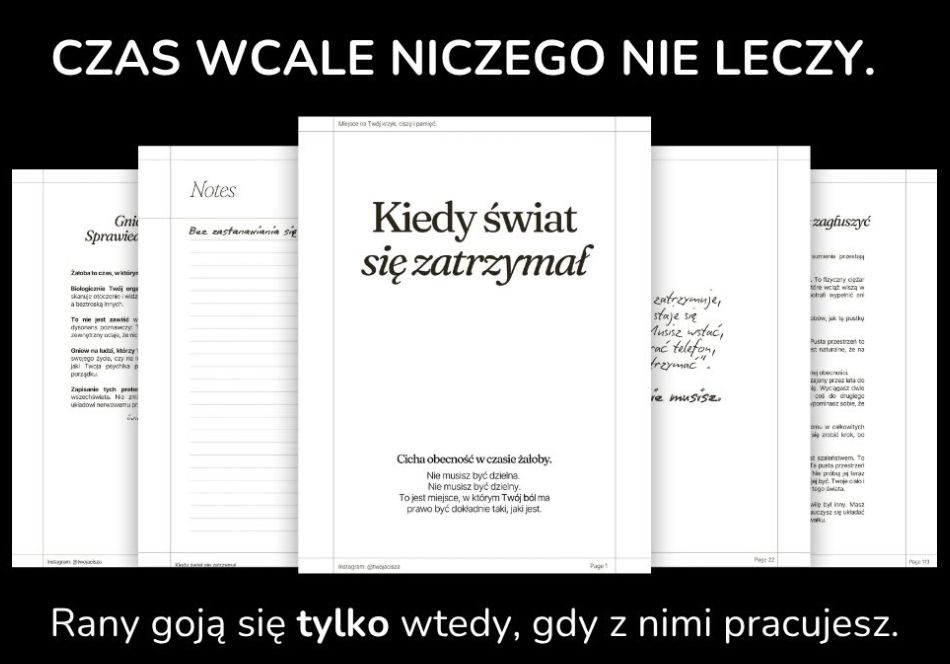
Twoja Cisza: My project is not an ordinary e-book with a wall of text, but a workbook of over 250 pages. It is not a classic medical or psychological guide, because, as I've said, I'm not a doctor. I created it as a tool with room to write out your darkest thoughts. The point is to go through that darkness step by step and not keep it all inside. Many people in grief are not under the care of a psychiatrist or psychologist, because, for example, they simply can't afford it, and state help is often unattainable. And in the evenings many people are left in such a state that they don't know what to do with themselves.
I wanted to give them the support I myself never received when I was looking for it most.
The idea came about because, after my mum's death, I was lying on the bathroom floor thinking I was losing my mind. I was afraid of my own emotions. I felt something so strong that I was convinced I'd end up in a psychiatric hospital. In this workbook I tried to explain that what happens in your head then is normal. Nobody talks about this. In schools we aren't taught about emotions and feelings, and we should be. I touch on very painful things there, but that's so you can stand shoulder to shoulder with what hurts and with what a person thinks but won't say out loud. In this workbook you can get it out of yourself, and no one will judge you.
TŻ: Your workbook stands out from others because it can be co-created. What needs of people in grief is it meant to meet, what can it help with? What are the exercises it contains for?
Twoja Cisza: This workbook has plenty of concrete strengths, which I want to state plainly, because each of these 252 pages was born from my own pain. Its greatest value is that it gives a person radical absolution. It lifts from their shoulders that monstrous compulsion titled you have to be brave, you have to pull yourself together, you have to cope better. It shows that if the only thing you managed to do today was simply stare at the ceiling, that is a great victory and, for that moment, entirely enough.
Another strength is that it lets you write ugly and chaotically, in words full of mistakes and smudged with tears. It gives you physical lines on which to pour out, without judgement, thoughts so dark and painful that a person is afraid to say them to anyone out loud, for fear of being thought insane. It helps break the paralysing noise and swarm of intrusive thoughts in your head with very simple, minimalist somatic and holistic techniques – for example rhythmic exercises like Tick Tack Tock, which don't demand any difficult analysis or logic from an exhausted brain.
A huge plus is also that it becomes a protective armour against the outside world. It contains ready-made, simple messages and "instructions" for loved ones, which you can just copy and send to them, so you don't have to answer prying questions for the hundredth time or explain your silence. It also helps you deal, very bluntly and honestly, with guilt and with that exhausting merry-go-round of thoughts titled "if only I had…". It doesn't try to fix a person by force; instead it stands shoulder to shoulder with their helplessness, giving them full sovereignty and the right to experience loss solely on their own terms.
TŻ: Who is it for – only people in grief, or also their loved ones?
Twoja Cisza: It is meant solely for people who have suffered a loss, who suddenly had to face a brutal reorganisation of everyday life and feel paralysed by the things the other person used to do – from handling passwords and bills to home repairs or insurance. It is for those who struggle with a terrible shame that, as adults, they suddenly feel as helpless as children in the face of life's ordinary matters, and who fear others' judgement. There I also show how loss destroys the physical body; I write about chronic stress, chronic fatigue, insomnia and the tests you need to do just to survive. The workbook also touches on the theme of relationships, which are brutally put to the test after a loved one's death, and teaches how to set firm boundaries with people who hurt you with their "wisdom". It is a space for regaining independence and putting in order both the technical and the emotional side of life in a world that has collapsed.
TŻ: The e-book helps you stop "what-iffing" and touches on what we consider a very important issue – forgiving yourself. What do people in grief often fail to forgive themselves for, or blame themselves for?
Twoja Cisza: A terrible belief has grown up around grief – that guilt appears only when something bad has happened – whereas the truth is that our mind is simply terrified of helplessness. The loop of self-accusation gives us the illusion that we had some influence over things. From my experience, and from what I address in the workbook, these reasons for self-blame are very mundane and painful.
Most often people torment themselves with so-called hindsight – today's knowledge held against yesterday's ignorance. They replay in their heads the film of the last few days and accuse themselves of a missed phone call, of an unspoken "I love you", or of choosing their own sleep and rest over a meeting. For ten years I myself carried a sentence for not driving my mum home after work a few days before her death, because I was tired – and so I saw her next only in the bedroom, when her body was already cold.
People in grief blame themselves for normal, human reflexes that were proof they were living ordinarily then, trusting that tomorrow would come. They torture themselves with thoughts that they could have known, foreseen and saved their loved one. The mind then applies a cruel filter, erasing years of presence and love and leaving before your eyes only that one frame in which you failed or didn't notice something.
A separate thing people blame themselves terribly for is what happens after the loss. They feel a burning shame and flog themselves for thinking about something else for a minute, for smiling at something, for buying a nice dress or going to the hairdresser. Subconsciously they feed their pain, because they fear that if they let go of the guilt and start returning to normality, it would be like betraying that person's memory. This workbook exists to pull all these tormenting thoughts out of the shadows, name them out loud and understand that true love never asked us for punishment…
TŻ: Your workbook allows you to be not-okay. It seems that this way of calling things by their name reaches many people. What messages do you receive from people who have used the e-book?
Twoja Cisza: The messages I get are, to me, incredible proof of how much people needed to feel that, in all this pain, they don't have to be brave. They often write to me in the middle of the night…
The most important thing I hear from them are words of relief: I've finally stopped feeling like I'm going crazy. People thank me that this e-book lets them simply be not-okay. They write about the weight that lifted from their hearts when they read that their paralysis, the fog in their head, losing keys or the fact that the simplest tasks take ages, is not any incompetence on their part, but proof of the mighty battle for survival their body is now waging.
I get messages from people who, for the first time in months, felt safe. They write that they only broke down at the empty lines in the workbook, because there they could, without fear or shame, pour onto paper their hardest, most painful thoughts, which they would never say to anyone close, because they know these pages will accept everything without any judgement.
Men write to me about shedding the armour of the "fixer". About how much they needed to hear that allowing themselves helplessness, weakness and tears does not take away their masculinity, but finally lets them be honest with themselves. These messages show me that this workbook gives people full freedom and tender permission to simply lie down, sob and be in pieces for as long as they need.
TŻ: What you have already done for so many people in need is invaluable. We know you've helped people go through what are often the hardest emotions of their lives. We wish you all the very best.
Twoja Cisza: Thank you.
The workbook "When the world stopped" is available here
Recommended articles

Eco-friendly grave lights – a conscious future for cemeteries?
Discover the TerraLight initiative and learn how eco-friendly grave lights help reduce cemetery waste, combining tradition with care for the environment.
Humanist funerals – why are they growing in popularity?
Learn what humanist funerals are and why they are growing in popularity. Discover how a secular ceremony unfolds and the modern forms of remembrance.

What happens to social-media accounts after death? – discover digital burial.
What happens to social-media accounts after death? Discover the idea of digital burial and protect a loved one's digital trace.